Caregiving is a lot to hold.
Empathic Aging helps family caregivers make sense of complicated situations, understand what matters now, and figure out what comes next.
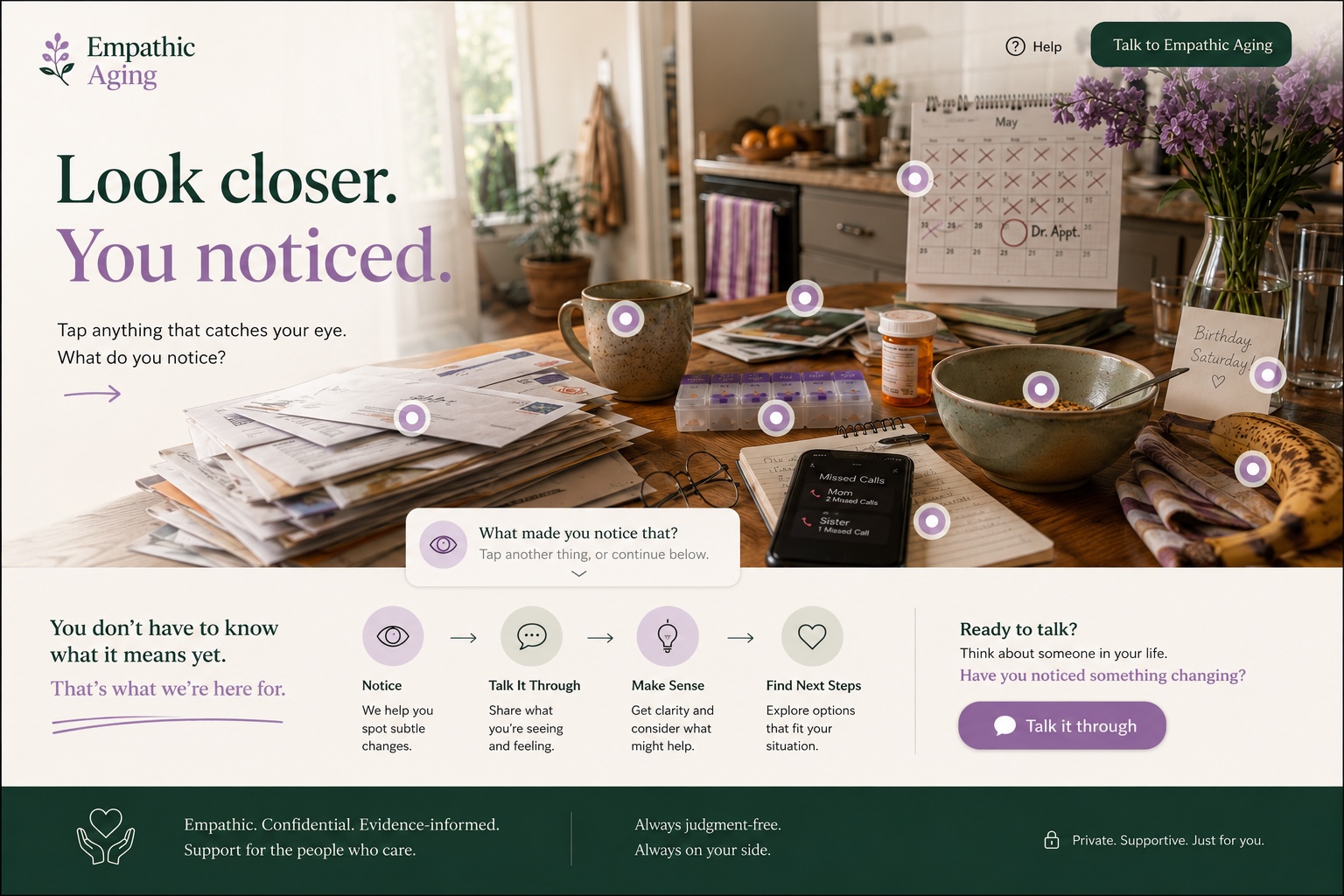
Look closer. You noticed.
You don’t have to know what a change means before you talk about it. Start with what caught your eye, and we’ll help you make sense of what comes next.
Less searching. More forward motion.
When everything feels important at once, we help you find what matters now—and what comes next.
Make sense of it.
Bring the messy version. We help you see the situation without asking you to solve every part at once.
Find your next move.
Focus on the question, call, document, or decision most likely to move things forward.
Know where to turn.
Start with trustworthy local, community-based, free, or income-based support before assuming private-pay help is the answer.
We never assume you already have a care manager, social worker, or professional navigator.
We explain why a resource may matter, what to ask, and which step is worth trying first.
AI can help organize and navigate. It does not replace clinical, legal, financial, or emergency professionals.
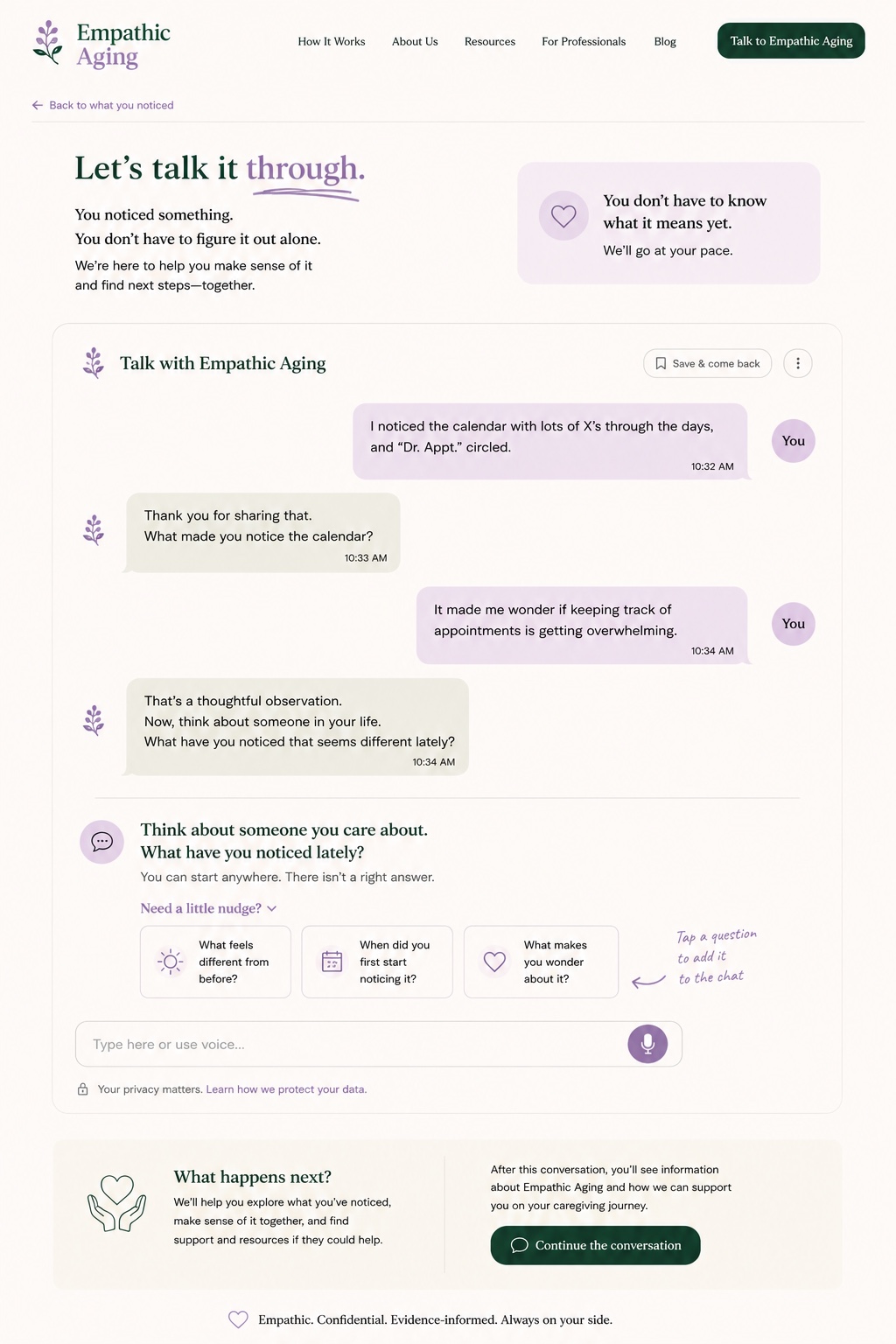
You noticed something. You don’t have to figure it out alone.
Share what you’re seeing, what has changed, or what you’re unsure about. Empathic Aging helps you make sense of the situation and find a next step at your pace.
Interested in user testing?
If you care for—or have helped care for—an aging parent, partner, grandparent, relative, or friend, your perspective can help shape what we build next.
Caregivers & families
Explore an early version and tell us what feels useful, confusing, missing, or genuinely helpful.
I’m interested in user testingOrganizations & professionals
Interested in caregiving innovation, research, collaboration, or a future partnership?
Explore a partnershipSee how Empathic Aging thinks through a caregiving problem.
This is a scripted product preview—not a live AI conversation yet. It shows the kind of support the Care Map is being built to provide.
You don’t have to organize it first.
Empathic Aging starts by listening for the decisions hiding inside the story.
Here’s what matters first.
What has changed with mobility, medications, personal care, meals, or safety?
What is she doing each day now—and what is becoming too much to manage alone?
Any plan should include their preferences, priorities, and what feels workable at home.
Start with one useful conversation.
Talk with Mom and Dad about what feels harder now. Sort the concerns into health, home, daily care, medications, transportation, finances, and family support.
You don’t need to solve the whole future today. A clearer picture helps you decide what deserves attention first.
Then move some of the load.
Look at what can move outside Mom: family or chosen family, community aging services, transportation, benefits, respite, home supports, or professional guidance when it is actually needed.
Keep the names, dates, promised equipment, and unanswered questions together so the next call starts where the last one ended.
Care is bigger than one person.
See the whole picture: the person receiving care, the people around them, the systems involved—and your own life outside caregiving.
Tap a circle.
This is a first look at the whole-life approach behind Empathic Aging. Caregiving is part of your life. It isn’t all of you.
What would give you actual breathing room?
Start with the amount of time you want—not with what you think you’re allowed to ask for.
Meals · medications · supervision · transportation · personal care · companionship · overnight needs
The eventual Care Map can help identify who or what might cover each piece—and where the gaps still are.
Know what you’re looking for before you make five calls.
Start close to home. Empathic Aging prioritizes reputable government, nonprofit, community-based, free, and income-based support when it’s available.
Community support
Food, housing, transportation, financial help, caregiving support and other local needs.
Search Findhelp.org →Legal help
Elder-law needs can include Medicaid, long-term-care financing, benefits, guardianship or nursing-home concerns. Estate planning can include wills, trusts and powers of attorney. Start with local legal aid or income-based programs when available.
Advocacy
Prepare for calls and meetings with the question you need answered, the facts that matter, and a clear record of what happened next.
Professional support
If outside expertise would genuinely help, we explain what kind of professional to look for. We don’t assume you already have one.
A small place to come back to yourself.
No productivity goal. No perfect routine. Pick something that feels doable for the next few minutes.
Stay here for a minute.
Choose a rhythm and follow the circle. We’ll keep count.
Put something gentle on.
The calm playlist stays available at the bottom of the site, so you can listen while you breathe, write, or doodle.
Five-minute creative reset.
You only need paper and something to write with. Pick one. Stop whenever you want.
What can wait until tomorrow?
Put three things on paper that do not need to be solved tonight.
These are optional, low-pressure ways to pause for a few minutes when you’ve been holding too much.
Built around the reality of family caregiving.
Empathic Aging is an AI-driven caregiving navigation concept designed to help people see the whole picture, reduce unnecessary steps, and find a practical way forward.
I’ve spent years working alongside older adults, people with disabilities, caregivers, and families.
Again and again, I’ve seen families trying to navigate complicated care situations while also managing jobs, relationships, finances, households, and their own lives.
Often, the problem isn’t that help doesn’t exist. It’s that people don’t know what kind of help they need, what to do first, who to call, or what questions to ask.
Caregiving can quickly become a second job that no one trained you for. Families are expected to understand healthcare systems, benefits, long-term care, home safety, legal planning, family dynamics, and community resources—sometimes while dealing with a crisis.
Empathic Aging grew out of that gap. I wanted to build something that helps a family see the whole picture, identify the next useful step, and connect with people and resources that can actually move things forward.
Just as importantly, I wanted the caregiver to remain visible—not only as the person responsible for everyone else, but as a person with their own relationships, identity, limits, interests, and need for rest.
The goal isn’t to keep someone inside an app. It’s to help them feel more capable outside of it.
Shannon O’Connor, LCSW
Founder, Empathic Aging · Social work, geriatric & disability care management, and family caregiver support experience
Care should feel human.
The philosophy is simple: respect the caregiver’s judgment, protect the older adult’s autonomy, make systems easier to understand, and bring in human expertise when it’s actually needed.
Want to connect?
Questions, collaboration ideas, or interested in partnering with Empathic Aging? We’d love to hear from you.